Showing posts with label Comic Books. Show all posts

Saturday, January 25, 2014

THE WOLVERINE (2013)


When it comes to superhero movies, I’ve been full of an awful lot of frustration these past couple years. Maybe it’s burnout, but something has been lacking since The Avengers. Either these movies have been way too self-important (Man of Steel, The Dark Knight Rises), too dumb (Green Lantern), or too silly (Thor: The Dark World) for me to really get behind them with any real geek enthusiasm. I’m not setting you up to tell you The Wolverine sets the genre back on its feet, or that it does anything particularly revolutionary. What I will tell you is James Mangold’s version is a fine story, with a strong performance from Hugh Jackman. It’s a quality movie – not a classic, nor the best example of the genre. Instead of swinging for the fences, it is quite satisfied with hitting a stand-up double.

Sometimes it feels like comic book movies have to outdo one another. Clamoring fans have really driven the work studios are putting out, and that has often felt like a detriment (have you seen Iron Man 2?). With every superhero flick, it is as if the ante is being upped, and the next story has to be bigger, better, faster, stronger, more. This is why we usually get sequels with end of the world scenarios, or more villains, or grand death scenes for important characters.

While I understand with all the money being thrown at these movies (The Wolverine is reported to have had a budget of 120 million) there is enormous pressure to make each sequel more epic, I would hope more filmmakers would take a moment to consider how comic books themselves are put together. Not every storyline in a comic book series has to have higher stakes than the previous one. Sometimes the storylines take a more introverted stance, or delve deeper into a running theme within the series, or take the character in a new direction as yet unexplored.

The Wolverine downsizes the epic scale we usually get in the X-Men films (I’m pretending X-Men Origins: Wolverine didn’t happen) and focuses on what turns out to be a pretty personal tale. He’s a wounded animal struggling with his will to live in the aftermath of the events of X-Men: The Last Stand. This movie takes Logan (Jackman) to Japan where he is reunited with Yashida, a man whose life he saved during the atomic bombing of Nagasaki in 1945. As a dying man, Yashida propositions Logan, requesting an exchange: he will take Logan’s mutant healing powers in exchange for the allure of death. Logan rejects, the old man dies, and the situation gets more complex at Yashida’s funeral when local gangsters try to take out Yashida’s cherished granddaughter, Mariko (Tao Okamoto). Unable to deny his nature to protect, Logan rescues Mariko and whisks her into hiding. Unfortunately, Logan has a big problem. Somehow his healing power has stopped working, and he becomes weak and mortal. Not only does he have to save Mariko, but for the first time in his life, he has to also save himself.

The Wolverine is at its best when Logan is struggling with the loss of his power. We learn more about the heart of a hero when he or she cannot rely on their strengths. The storyline is similar to Shane Black’s vision in Iron Man 3, which found Tony Stark having to make do with a malfunctioning suit of armor and no lab to get another. Where Iron Man 3 was more interested in using the lack of power to humble Stark, The Wolverine is more interested in watching its hero grapple with mortality. Wolverine’s greatest struggle as a hero – the essence that makes his character endure – is that he, like a vampire, cannot die. He is brave, tough, macho, and all that, but deep inside he’s devastated at the suffering he’s witnessed, and the friends and lovers he has lost. His will to live is always under attack, and it is the only thing that can truly hurt him since guns and knives and sharp swords have no long lasting effect. Suddenly, without his mutant powers, Logan still must find the resolve to fight. The scenes in which he a Mariko are on the run are the movie’s finest, and the fight sequence on top of Japan’s bullet train is exhilarating as a result.

Once the film resumes the standard hero movie beats in its final act, it becomes sort of ho-hum, but not without its charms. Especially charming is the casting of Rila Fukushima as Yuriko, Mariko’s adopted sister who brings Logan into the Japanese storyline and eventually assigns herself the role of his bodyguard. She is fun to watch on screen with her lynx-like jaw and lithe kung-fu movements. I would be thrilled to watch a film chronicling the exploits of Yuriko and Logan as they travel around like badass samurais –it would be the Marvel Comics version of Akira Kurosawa legend. Not so much fun are the standard issue villains/shapeshifting rogues, Viper and Shingen. Viper is sexy and all that, but after watching Mystique in previous X-Men movies, it’s hard not to yawn. And Shingen, who starts the movie as a cool outsider, plays a role that is paint-by-numbers with a performance as dry as unbuttered toast.


The Wolverine is not going to set the bar higher for comic book movies, but I think that is a good thing. Its low key tale is evidence that if the superhero genre is going to thrive, we need more attempts to tell stories like these. With Marvel’s second wave about to kick start this coming summer with Ant-Man, I have a feeling this may be the case.

Other Thoughts:

* Despite enjoying this movie, I was rather concerned with most of the action scenes. Wolverine's claws make him a deadly character, so it is next to impossible for him to fight with a group of people without killing anyone. Because of this movie's PG-13 rating, the fights are incredibly bloodless, and Wolverine tosses most of his enemies aside like rag dolls when it is obvious he just cut them to shreds. At times this also seems to undercut the major theme of fighting for the will to live. When life is so easily, and bloodlessly taken, it almost makes life look like it is not all that valuable. Mindless, consequence free violence is a prevalent trope of the action genre, and isn't nearly as off putting as it could be in this movie, but it does give one room to pause and consider the idea that maybe the PG-13 rating is sacrificing significance for a teenage audience.

* I laughed my ass off at the beginning of the movie as Logan emerges from his cave in the woods. For a moment, I imagined a scenario in which Jackman finished working on the set of Les Miserables, then sprinted across the studio lot to shoot these scenes in The Wolverine. I kind of hoped he would start serenading Jean Grey in his dreams.

* The now traditional closing credits tease scene was fun, and definitely sets up this summer's X-Men: Days of Future Past by having Wolverine intercepted in the airport by a couple old friends. But I did find myself wondering where the hell Yuriko was, since the title card tells us the scene takes place two years after the conclusion of the movie.

* Jackman is so ripped for this film that he single-handedly does for men what the movies have been doing to women for the last century: breed rampant insecurity. I will continue to ponder this as I crack open another Coke and shove a handful of Doritos into my mouth...

Wednesday, June 26, 2013

A Cinematic Delight That Almost Destroys Itself -- Reflections on "Man of Steel" (2013)

Iconic. Vintage Snyder.
Man of Steel is an exhilarating superhero epic that flies at a blistering pace. It’s perfect spectacle, and packed with iconic imagery care of Zack Snyder’s keen eye. There is so much the movie gets right, from the inspired casting to the remarkable special effects work to Hans Zimmer’s powerful score. This is an excellent Superman movie, but it is hard for me to imagine I will rewatch it again and again once it hits HBO in about 10 months.

The reason is the Christopher Nolan effect.

Now, I love the work of Christopher Nolan. Excepting The Dark Knight Rises (which only gets worse on repeat HBO viewings), his films have always resonated with me. He loves a good puzzle, and his works are entertaining in a remarkably cerebral way without sacrificing the overall impact of the drama, or the joys of spectacle. This is especially true in The Dark Knight and Inception, his most mainstream films.

The downside to Nolan, as evidenced by his Batman films, is the need to make everything so damn realistic, moody, and serious. This worked well with the first two Batmans in his trilogy, but by the third it worked against him as the tone was completely usurped by an absurd labyrinth of a plot that when finally pieced together resembled nothing even remotely real.

Now, with Man of Steel, he – and collaborator David S. Goyer – are up to it again, this time bringing Zack Snyder, a director with a knack for taking material too seriously (re: SUCKER PUNCH), into the fold. Snyder provides the visual punch of the film its saving grace, but Goyer provides a script that at times takes itself way too seriously. I wasn’t always sure why a Superman film had to be so grim and despairing, and while I rooted for our red, white, and blue superhero, I found myself wishing he’d lighten up just a little bit.

None of this is to put down the film, or imply that I didn’t like it. I did. I just see a pattern in Nolan’s superhero work that worries me. He seems intent on sucking all the fun out of superheroes. Fortunately, the general story here is strong, and Henry Cavill’s Superman along with Michael Shannon’s Zod are worth watching. Shannon, particularly, crackles when onscreen; Zod’s genetically engineered destructive force is almost worth the price of admission alone.


While Man of Steel may be a cause for alarm for the critic in me, reaffirming the ultra-serious aesthetic of modern comic book hero movies both creatively and at the box office, it is still great to behold on the big screen – a cinematic delight.

Standard With a Few Surprises -- Reflections on "Iron Man 3"


This is a pretty serviceable Iron Man film. Far superior to the 2nd entry in the franchise, but still lacking the anarchic fun of the first film. In this installment, Tony Stark pisses off a terrorist called the Mandarin, gets his house destroyed as a result, and has to find a way to save the day. Shane Black, who has written some great films (Lethal Weapon, The Last Boy Scout, Kiss Kiss Bang Bang), brings his darkly comic sensibilities to the table as director and gives us a good time at the movies.

The best thing about the movie is Ben Kingsley as the Mandarin. He is full of surprises, and manages to recharge the film enormously whenever he’s on screen. I imagine several comic book purists were really pissed off by Black’s treatment of the Mandarin, but I thought it was original and a fairly decent satire of our media’s love affair with terrorism.

Otherwise, Iron Man 3 is a pretty standard superhero flick, hitting all the required beats on its collision course with a pulse-pounding, blow-em-up-good ending. On a sidenote, I keep wondering how long audiences will indulge Robert Downey, Jr.’s performance as Tony Stark. Obviously, he’s very convincing in the role, but it feels remarkably true-to-life somehow. At times, he is grating even though the film is trying to make him endearing. In The Avengers, this quality was an excellent foil for Captain America, Thor, et al, but in his own films it seems to make him just seem more and more like an unlikable jackass. Is this what we want out of our heroes? Is it what we deserve?

Thursday, July 26, 2012

What Batman Has Become -- Reflections on "The Dark Knight Rises" (2012)


'Sup, bro! Let's get ready to rumble!


Batman is an amazing character. He’s specific enough to be relatable, yet general enough to be universal. On one side he’s a man possessed by anger and a desire to serve justice as he sees it; on the other, he’s an anonymous masked man upon which anyone can project their own identity. As a result, everyone has their own idea as to what they think Batman is, which may explain why he has been so malleable over the years, able to be a dark knight detective, a playboy vigilante, and a campy crime fighter without ever truly compromising or destroying the vision of creator Bob Kane.

Like it or not, Christopher Nolan has a definite idea as to who he believes Batman is. In Batman Begins, he was a revenge seeking millionaire with the training of a terrorist. With The Dark Knight, he was the morally ambiguous symbol caught between Harvey Dent’s altruism and the Joker’s anarchy. And in The Dark Knight Rises, Nolan’s climatic third act of this trilogy, Batman is a pussy.

That’s right. He’s a pussy.

We begin The Dark Knight Rises seven years after the end of the previous film. The story Batman and Jim Gordon concocted in the wake of Dent’s death has turned Dent into a saint and led to the creation of the Dent Act, a law that has somehow managed to put an end to due process and keep all members of Gotham’s organized crime syndicates behind bars forever. Gotham has never seen better days, and Batman is nowhere to be found. Wayne has hung up the cowl and taken up a cane and a case of clinical depression. According to Nolan’s story, Bruce Wayne has stopped being Batman because Rachel Dawes died. His parents died and he thirsted for revenge so badly he wound up in a terrorist group, but when his girlfriend dies, he quits. It’s a thin motivation to say the least.

I understand why Nolan thought this was a good idea. It all stems from the George Lucas/Joseph Campbell school of hero storytelling, in which the hero refuses the call to adventure. And that’s what Bruce Wayne does for a huge bulk of the film, until he is drawn into the adventure by Selina Kyle (Anne Hathaway), a master thief who lifts his fingerprints while masquerading as a servant. Why does she need Bruce Wayne’s fingerprints? It’s complicated, almost needlessly so.

It’s all a part of an epic plan by Bane (Tom Hardy), a masked terrorist who looks like a cross between Darth Vader and Steve Austin. This plan begins with the abduction of a nuclear physicist in a brilliantly staged action sequence that made little sense, and involves an invasion of the stock exchange, the destruction of a football field, and the release of every criminal in Gotham in the name of “liberation.” Who is being liberated? Bane suggests it’s everyone in the city, but since Gotham is only populated by criminals, police, rich assholes, and orphans, it’s hard to tell.

Bane’s whole plan is like a game of Jenga, every piece needing to be carefully moved just so that it won’t come crumbling down, making it all feel remarkably contrived. I don’t think I would have minded this so much if I felt more closely connected to Bane. It’s not until the end of the film that we understand Bane’s motivation clearly, and it’s too little too late. Nolan really does Bane a disservice here, not doing much more than making him menacing without providing us significant reason to feel the weight of that menace. He holds the cards of Bane’s motivation too close to the chest, wanting to avoid giving away a great plot twist that he ultimately sacrifices what could have been a powerful character.

As Bruce Wayne inevitably decides to don the cowl and the gravelly voice again, other characters emerge on the periphery of the story. John Blake (Joseph Gordon Levitt) is a beat cop on the rise with a heart for orphans, and a nagging suspicion that Batman is still around. Along with Selina Kyle, Blake helps bring the Batman back, then proceeds to work behind the scenes with Commissioner Gordon to stop the most disturbing part of Bane’s diabolical plan. We also meet Miranda Tate (Marion Cotillard), a wealthy do-gooder who wants access to a fusion reactor Wayne Industries has hiding under Gotham to create alternative energy. As with Bane’s motivation, Miranda Tate’s is equally unclear until it’s too late to make it dramatically appealing. It’s almost as if Nolan, obviously an acolyte of Alfred Hitchcock, forgot Hitchcock’s rule about preferring suspense over surprise. In this film, he’s in love with surprises, but without clearly defined characters, the surprises have no emotional resonance; they are just hollow twists meant for people to tweet or text “WTF” to their friends.

While most of this review has been negative – because there is a lot to be frustrated with in The Dark Knight Rises – there are some definite positives, too. I love Anne Hathaway here as Selina Kyle, who is – in classic Nolan style – never called Catwoman. She’s scrappy, funny, sexy, and well-written. Hathaway is having the time of her life playing this character, and it shows. Equally excellent is Joseph Gordon Levitt as John Blake. Levitt is such a likable actor, and as with Selina Kyle’s character, his is clearly defined, making the gimmicky ending feel a little less gimmicky. Gary Oldman, Morgan Freeman, and Michael Caine as Gordon, Lucius Fox, and Alfred respectively, do their thing and do it well. Michael Caine, especially, gives a great performance; the scene where he must face the consequences of burning Rachel’s letter from The Dark Knight is one of the film’s finest.

Technically, of course, Nolan’s direction shines. The stunts are incredible and jaw dropping, the vehicles super cool, and the visual effects gorgeous. This is expected. Nolan is one of our finest visual directors, his compositions stunning, and the camera movements purposeful and exciting. I can’t think of anyone who can stage a better chase sequence than Nolan.

I just wish more had been invested in creating a villain we could become invested in. In Batman Begins, it didn’t matter so much that Ra’s Al Ghul and the Scarecrow weren’t particularly interesting because the story was all about Bruce’s personal journey of self-discovery. The Joker was a force of nature and Heath Ledger’s iconic performance brought us into his crazy, demented world. With Rises, though, Bane needed to be more than just scary – he needed to resonate.

And Batman needed to be more of a man, or at least more of the man we thought he was after the first two films. But it’s obvious that the problem with this film is that Nolan doesn’t believe in Batman, even if the characters in his story pay lip service to the notion that they do. He doesn’t believe a real man would want to play dress up and play judge and jury with criminals, all the while toeing the delicate line between good and evil. He believes that Batman would be undone by a broken heart, but not by a broken back. This doesn’t sit well with me as a lifelong fan of Batman, but that’s not important. What’s important is that it doesn’t jibe with the character we were given back in Batman Begins. This is a change that feels contrived because the character was written into a corner.

Oh well. Despite what I think, The Dark Knight Rises will impress many with its lavish set pieces, epic scale, and iconography. It’s a spectacle, a flawed, flawed spectacle.

Saturday, April 7, 2012

A Love Letter to Geeks -- Reflections on "Comic-Con Episode IV: A Fan's Hope" (2012)


Geeks are heroes, too!
My first – and only – experience at the San Diego Comic Convention was when I was 11. My dad and I joined a group of comic geeks at our favorite San Bernardino comic shop, Lone Warrior Comics, and took a charter bus deep into the heart of San Diego. On the road, we watched old Batman serials on the tiny TV at the front of the bus. My heart was pounding the whole way there, full of every fanboy’s fantasy of meeting all my creative heroes.

The experience of Comic-Con was immersive. I remember feeling overwhelmed as I stepped onto the showroom floor, suddenly swimming in a sea of dealers with the coolest comics, posters, shirts, and every conceivable collectible I could think of. All I had burning a hole in my pocket was a paltry $20, but I was going to make it count for something. The only thing I remember buying was a Joker T-shirt with an image of the Joker from Alan Moore’s Batman: The Killing Joke, illustrated by Brian Bolland.

My most vivid memory of the experience was a random encounter with comic writer, Peter David. He was a portly man with a comb over and thick glasses, but when I saw that name on his badge, suddenly he looked to me like I imagine young boys in my grandfather’s generation would have looked at Mickey Mantle or Muhammad Ali. “You’re Peter David!” I exclaimed. To which he quickly responded: “Yes! And you’re Jeremiah the Bullfrog!” I don’t remember the conversation we had afterwards – I think he spent a few minutes telling us about all the cool stuff he was working on – but two things came out of that meet. First, he autographed the copy of Web of Spiderman #1 I was carrying in my backpack, and secondly, I never got upset at being called a bullfrog ever again.

Morgan Spurlock’s documentary, Comic-Con Episode IV: A Fan’s Hope, reminded me of being that kid again, 11 and star struck, in love with the art and bombast of comic books. I stopped collecting comic books right after high school, and have only dabbled here and there in the medium since, but this movie reminded me why I was proud to be a geek back then, and why I am still proud to be a geek now.

The documentary tells the stories of several people who are headed to Comic-Con for various reasons. Some are there to show off their artwork in hopes of scoring a job in the industry. Others are there to get highly coveted collectibles. A comic book dealer, whose business is floundering in our economy, has pinned his hopes on making enough money to save his once blooming business. And a young man is looking to propose to his geeky girlfriend at the Kevin Smith panel. By looking at all these different perspectives, Spurlock shows us that Comic-Con is truly a microcosm of what’s happening in America and across the globe. In so doing, he also reveals the only true solution to what ails us – passion, pride, and hard work.

Along the way, the stories of our featured geeks are punctuated by brief interviews with a number of celebrities and geek icons: Stan Lee, Kevin Smith, Edgar Wright, Eli Roth, Joss Whedon, Todd MacFarlane, Robert Kirkman, Harry Knowles, and a slew of others, including random fans and convention attendees. While the interviews are short and succinct, often meant for a laugh, it’s evident that Spurlock wants us to realize that we’re all in this together, the fans and the creators. We fans may put them on a pedestal, but they put others on them, too. As a fanboy, I like knowing this.

What will the average film goer think of this movie? Probably what the average film goer thinks of Comic-Con in general, I imagine. But it doesn’t much matter. The only opinions that matter on this film are those of the fans, because this movie, above all else, is a finely penned love letter to geek culture and fandom. Like the young lady that builds costumes based on characters of Mass Effect 2 in her San Bernardino, California garage, this movie knows who it’s being made for – the fans. For people like me, who will always remember his first Con experience with religious intensity.

Friday, July 22, 2011

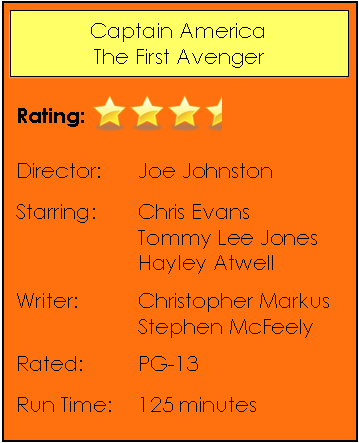
Cap Ranks with the Best -- Reflections on "Captain America: First Avenger" (2011)

Good thing his suit is CGI-retardant.
Here's the list of the great superhero films:

1. The Dark Knight
2. Spiderman 2
3. X2
4. Iron Man
5. Superman 2

Maybe it's because I'm giddy with enjoyment, or because my love for the hero goes all the way back to the halcyon days of my youth, but I'm ready to place Captain America: The First Avenger at number 5, ahead of the classic Superman 2 and all it's Zod-related goodness.

Captain America is, simply put, a delight. It's an old fashioned superhero yarn with none of the cynicism, none of the angst, and none of the pretension most of the recent crop of comic book films have had. It tells a straightforward story, doesn't bog us down in tons of tedious details, and gives us a protagonist we not only can root for, but love.

The last time I fell in love with a hero in a movie was Tony Stark in the first Iron Man, but that was because he was so charismatic that I fell under his spell. Steve Rogers, on the other hand, is the quintessential underdog whom, even after he's been augmented by the Super Soldier experiment, still manages to remain humble, genuine and good. It's not the wholesome goodness of Christopher Reeves' Clark Kent/Superman; it's a rugged goodness, like that of an honorable knight.

Besides the protagonist, though, there is much to love about this film. From the set design to the inspiring score by Alan Silvestri to the excellent character performances by Tommy Lee Jones, Stanley Tucci, Hugo Weaving and Hayley Atwell, Captain America is a comic book/movie fan's treat.

Basics: Steve Rogers (Chris Evans) is a 90-lb. weakling who has the heart of a warrior. He wants nothing more than to become a soldier to fight the Nazis in World War II, but due to a series of ailements, the least of which is ashtma, Steve continually gets rejected 4F. After meeting scientist Dr. Erskine (Stanley Tucci), Steve is accepted into the military to be a part of an experiment to create super soldiers. The experiment works and he becomes Captain America, a great American hero. From there he falls in love, meets a slew of friends and comrades-in-arms, and goes toe-to-toe with the nefarious Red Skull (Hugo Weaving).

Classic Storytelling Techniques: One of the best things about Captain America is the use of montage to show the passing of time. It helps solve the problem most superhero origin stories have, which is having to front load exposition just to make the main story understandable (this is why so many of the best superhero films are sequels, because sequels don't have this problem). Once Steve becomes Cap, director Joe Johnston uses montages to show how Steve develops as a character. He doesn't get the chance to immediately become a hero, being given the choice to either become a laboratory guinea pig, or become a costumed spokesman for war bonds. Later, we get another montage showing his pursuit of the Red Skull's Hydra bases, which results in some fun explosions and special effects without the tedious necessity of setting up each mission. The use of these montages is very similar to 1940s/50s war films and not only propels this story, but serves as a wonderful tribute to the golden age of cinema.

A Strong Female Presence: One of the biggest problems with superhero films in general is the lack of strong female characters. Usually, most superheroes are men, so the women are delegated to basic roles, like supporting friend and love interest. They often get the lamest dialogue and become plot props of the woman-in-peril variety. Even in the best superhero films, like The Dark Knight and Spiderman 2 we see this happen. In Captain America, the female lead, Peggy Carter (Hayley Atwell) is more than a love interest. She's a British agent on assignment to assist the American Army. She is highly trained, holds her own against the men, and yet is still allowed to be feminine. Atwell plays Carter with a remarkable external strength that belies an inner sensitivity. The way the film builds her relationship with Steve Rogers is beautiful, and makes the pay off both memorable and tragic. It's rare that you can call a female in a male superhero movie essential, but Peggy Carter absolutely is.

Avengers Assemble!: One of my biggest concerns about Captain America when I first learned that it would be set in the 1940s was how they would connect his character to The Avengers film coming next year. After all, Iron Man, Hulk and Thor all took place in the current timeline and all had interactions with Nick Fury (Samuel L. Jackson). Well, I should have be a bit more trusting. Not only does Captain America connect cleanly to The Avengers, it establishes a context for the team's existence, and gives the cinematic Marvel Universe a history. I like how Tony Stark's father plays a central role in the creation of Cap and his fight against Hydra. And I love how the conclusion of the film sets the stage for not only Cap's involvement in the Avengers, but the evolution of his character. All this, plus The Avengers trailer tagged on to the end of the credits make me extremely excited for next summer.

I will no doubt have to re-watch Captain America a few more times to determine where it fits in the pantheon of super hero movies, but the fact that I'm so avid to see it again assures me that it does indeed rank right up there with the best.

Sunday, May 8, 2011

A God We Can Relate To -- Reflections on "Thor" (2011)

"To kick ass or not to kick ass? That is the question!"
As a kid, I was obsessed with comic books. Spider-Man, Daredevil, Batman, Hulk, Captain America, The X-Men were my idols. I would pin my favorite covers up on my bedroom walls like posters and was paid my weekly allowance in comic books instead of cash. Somehow, my dad knew I'd turn that five bucks a week into a couple new issues and a Big Gulp. I pretty much read every title I could.

Except Thor.

Friday, November 27, 2009

On Marriage and X-Men -- Reflections on "X-Men Origins: Wolverine"

About a year before my divorce, my ex and I finally decided to get marriage counseling. Yes, after 12 years of marriage, we realized it was time. Counseling was great, and did some good; it was like putting a band-aid over a deep gash, spraying some Bactine on it, and calling it a day. Suffice to say, we filed divorce, and our much better friends because of it.

What is the moral of the story? I guess there is one somewhere in there.

X-Men Origins: Wolverine is a lot like the endgame to my marriage. Too little, too late. It plays like an afterthought to the X-Men trilogy. Did we really need a movie about Wolverine's early days to make us enjoy the trilogy even more? It's like what George Lucas did for Star Wars by creating a set of prequels. Some things are better left to the imagination of the viewers, like the Clone Wars -- seeing them only cheapened our fantasies.

The same is true here. The first two X-Men movies gave us a healthy dose of Wolverine's backstory. We knew about Weapon X. We knew he had amnesia and that he was meant to be a government tool. We knew he had a really fucked up connection to William Stryker. Did we really need to know anything else? Obviously some will disagree with me, but ask me if I really care.

To set the record straight: this movie is quite watchable, and if you turn your brain off, it's not bad either. Hugh Jackman is solid as always as Wolverine. Liev Schrieber is pretty cool as Sabretooth, Wolverine's big, bad brother. The action sequences, while not particularly original, are staged well and make for a fun popcorn popping time.

But this doesn't mean it's a good superhero movie. It's mediocre at best. The biggest reason for this is because the whole story is a flashback. It plays like a pause in the middle of a larger story. And the problem with most flashbacks is that they slow down the action in the main story. The X-Men trilogy had a forward momentum going (even though X-Men: The Last Stand sucked), which means this movie interrupted our need for the next chapter. This is how flashback chapters work, especially when the information presented doesn't particularly offer any new revelations. Flashbacks slow shit down and can be really annoying. Only really good writers can make it work, and the writer's of this film are not that good.

So, in the end, X-Men Origins: Wolverine isn't much more than a 97 minute diversion from more important things to do, like getting on with your life. It's a lot like marriage counseling at the end of the marriage -- you're not hearing anything you didn't already know, feel like something good is happening while you're there, but realize after it's over how hopeless the marriage really is.